The EU Office in Belfast is the eyes and ears of the Commission in Northern Ireland and is constantly alert to what the EU can offer here whether that is economically, politically or socially - but Northern Ireland must make its views known and negotiate through London, according to Colette Fitzgerald Head of the EU office in Belfast.
Speaking at a NI Grain Trade Association lunch, Colette referred to May 2007 and the signing of the Good Friday agreement when £2 billion European Peace Money was awarded to develop the economy in Northern Ireland and grow the private sector.
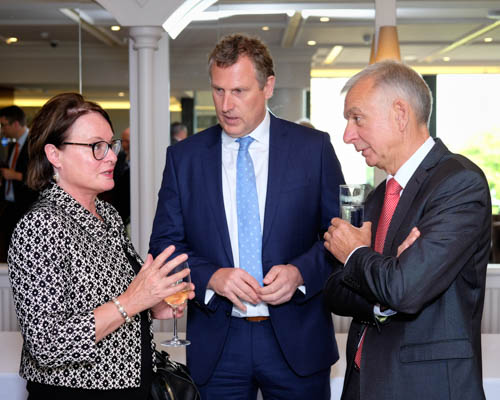
Colette FitzGerald, head of EU Office in Belfast was Guest Speaker at the NIGTA quarterly meeting and is pictured chatting to NIGTA President, Keith Agnew and Chief Executive, Robin Irvine, right. Photograph: Columba O'Hare
For the past seven years the EU office has been helping Northern Ireland to access the Horizon 20/20 fund of 80 billion euro. Northern Ireland has been awarded £175 million from this fund and Colette is very keen to increase Northern Ireland's engagement.
As head of the EU’s Belfast office Colette stressed that all of the Northern Ireland issues are reported back to Brussels on a daily basis and are considered along with those from all of the other member states. However NI is not a member state so has no direct voice – it must communicate with the EU through the UK's negotiating structure. For this reason NI must get its message across in London and hope to achieve a favourable outcome for Northern Ireland in the negotiated settlement.
Colette went on to point out that the EU negotiators understand Northern Ireland through involvement in the peace program and will be keen to see a solution which works for the whole of Ireland. While there is a two year window for Brexit negotiations each country will have to approve the deal between the EU27 and the UK and finally the EU parliament has to approve the deal.
It will be a lengthy process and it must be remembered Brexit is not as big an issue for the rest of the EU as it is for Britain - their attention is focused on the EU budget for 2020 which costs each country 0.9% of its GDP.
She finished by pointing out that the scale of what needs to be negotiated is mind boggling – everyone is in uncharted waters and the impact on Northern Ireland will depend very much on our ability to influence opinion in London.
NIGTA June Meeting 2017
NIGTA members Phillip Moore, Alan Bristow and David Kernohan at the Grain Trade quarterly meeting. Photograph: Columba O'Hare
Michael McAree, Vice President, NIGTA; Keith Agnew, President, NIGTA and David Garrett, NIGTA at the NI Grain Trade Association quarterly meeting. Photograph: Columba O'Hare
NI Grain Trade Association members Niall O'Donnell, David Garrett, Ronan McCanny, Norbury Royle and Clarence Calderwood at the NIGTA quarterly meeting. Photograph: Columba O'Hare
Robin Irvine, NIGTA Chief Executive; Michael McAree, NIGTA Vice President and Keith Agnew, NIGTA President with Colette FitzGerald, head of EU Office in Belfast, guest speaker at the NI Grain Trade Association quarterly meeting. Photograph: Columba O'Hare
Keith Agnew, right, President NIGTA and Robin Irvine, Chief Executive, NIGTA chat to guest speaker Colette FitzGerald, head of EU Office in Belfast at the NI Grain Trade quarterly meeting. Photograph: Columba O'Hare
Colette FitzGerald, head of EU Office in Belfast was Guest Speaker at the NIGTA quarterly meeting and is pictured chatting to NIGTA President, Keith Agnew and Chief Executive, Robin Irvine, right. Photograph: Columba O'Hare
Doris Leeman, NIGTA Secretary and NIGTA members George Starrett, Fiona McCord and Basil Bailey at the NI Grain Trade quarterly meeting. Photograph: Columba O'Hare
Keith Agnew, right, President NIGTA and Robin Irvine, Chief Executive, NIGTA at the NI Grain Trade quarterly meeting with guest speaker Colette FitzGerald, head of EU Office in Belfast. Photograph: Columba O'Hare