For the second year in a row feed businesses have returned from the Christmas break only to find events during the Christmas period have caused commodity prices to bounce. With Wheat prices rising £10 and soya rising $39 per tonne from their mid December low, hopes for feed price reductions early in the New Year have been stifled.
The causes, unfortunately, are as much to do with the knock on effects of world politics and the Euro Debt Crises as to the fundamentals of supply and demand for feed commodities, which over Christmas have started to reflect concerns over drought worries in Argentina and Brazil.
Gunboat diplomacy by Iran, threatening oil supplies into Western Europe has pushed oil prices up 9% to $113 from the mid December low, making bio ethanol once again, a more attractive market for cereals. In parallel, sellers of wheat are more reluctant to switch from a commodity which protects them from exposure to the Euro Debt Crises. Their decision to hold rather than sell, has been reinforced over the last two months as the Euro has fallen 9% against the Dollar and over which a great deal of uncertainty currently hangs over its future value. Both factors have combined with drought worries in Argentina and Brazil, to put upward pressure on both Wheat and Soya over the Christmas period
A spokesperson for the NI Grain Trade Association said. “The industry is hopeful that this is a short term bounce in the market and is stepping back, as best it can, in the hope that markets will revert to their pre-Christmas downward trend. However even if this was to happen, it would take time. In the interim, to ensure material is physically available over the next few months requires much of it to be bought now, frustrating pre-Christmas hopes of price reductions on feed in the early part of the new year. “
Given the highly volatile situation that exists in the world today and the domino effects they tend to have on commodity prices, it is still very much a wait and see approach by the industry as to what pricing might turn out to be by the end of the winter season.
Discussing feed material prices with the NI Grain Trade Association. Diane Dodds, welcomed the news of some softening of prices. Claudine Heron, President told her ‘As NIGTA we have had to deal with the volatile pricing of recent times but some softening of grain and soya levels will feed through ration prices in the coming weeks. However, going forward the markets will be susceptible to harvest vulnerability and the macro global markets.”
Speaking after her meeting with NIGTA, DUP MEP Diane Dodds has said that competing global demands for land use poses challenges for the agriculture industry. Mrs. Dodds also reiterated her calls for a swifter system to deal with GM tolerance and approval.
Mrs Dodds said:
“Meeting with the Northern Ireland Grain Trade Association (NIGTA) was extremely helpful and important. Northern Ireland is a huge importer of grains from across Europe and the World. Given the nature of the intensive production methods we have in Northern Ireland we rely heavily on the need for a constant supply of raw materials and also of cheap materials.
Unfortunately due to volatile markets, weather fluctuations, the drive to increase bio fuel production and speculation the price of raw materials has increased greatly, having a negative impact on livestock farmers’ profit margins. Pressures on land use across the world it definitely changing. The current drive within the USA for bio fuels and indeed across the world is something the agriculture industry will have to adapt to. Of course when demand for a certain raw material increases so will the price. In the UK we should also be aware that many bio fuel plants will be coming into production in the next few years adding even more competition.
While I believe grain prices should increase and allow arable growers an opportunity to improve profit margins and cushion against the huge increases in input prices and years of extremely low profit margins, farm gate prices for other produce needs to increase. During the meeting it was also expected grain prices would stay at historical high levels, but it will all depend on the harvest yield, exchange rate and the relaxation of export bans across the world.
During the meeting NIGTA also highlighted issues which its members are facing in the world market and also at home. The need for a continuous review of the GMO tolerance level and the need for a more efficient GM event approval system are extremely important to ensuring the supply of raw material and hopefully allowing price reductions. NIGTA plan to introduce a new co-ordinated plan and risk based testing programme for raw materials and also compound feed, which will reduce the potential for food contamination e.g. dioxins. I think this is a very responsible position that NIGTA has taken. If successful this will help protect the farmer, processor and the consumer.
Claudine Heron added “The agri-food industry is critical to the economic recovery of Northern Ireland, this was highlighted in a recent DARD report showing how the industry turn-over has grown throughout the recession by nearly £500 million since 2008 to 2010 estimated at £6.68 billion. This was achieved through investment and a growth of sales both at home and in export markets. For this to continue not only does the industry need to continue to strive for quality guarantees and innovation but government bodies need to lend support to enhance export opportunities. For example, for pigment and dairy products, and they should not add additional red tape and costs to business.
Progress on implementation of the Nitrates Directive in Northern Ireland was the subject at the latest quarterly meeting of the Northern Ireland Grain Trade Association. Bringing the Association up to date and outlining the challenges for the future were Dr Sinclair Mayne, DARD and Dr,Fiona Wilson DOE.

The Nitrates Directive is a European Union Directive which aims to improve water quality by protecting water against pollution caused by nitrates from agricultural sources. Whilst low nitrate concentrations predominate in river, lakes and groundwaters in Northern Ireland, most lowland lakes are classed as eutrophic, primarily as a result of phosphorus enrichment. In 2000, the European Commission determined that nitrate inputs must be controlled in situations where freshwaters are eutrophic.
In 2004, the whole of Northern Ireland was established as the area to which a Nitrates Action Programme should be applied in order to address the widespread nutrient enrichment of rivers and lakes. In January 2007, revised action programme regulations were introduced which apply to all farms in NI.
Key measures of the 2007-2010 Action Programme included:
Storage requirements for livestock manure.
Closed periods for manure and N fertilizer application to land.
Limits on rates of N fertilizer and livestock manure application.
Restrictions on methods and environmental conditions for fertilizer and manure application.
Requirements for record keeping.
In order to assist the industry to comply with the increased livestock manure storage requirement, DARD introduced the Farm Nutrient Management Scheme which provided 60% grant aid for over 3900 projects across Northern Ireland. The Scheme resulted in a widescale upgrading of farm infrastructure, with a total investment of over £200m. DARD provided grant aid of some £121m with farmers contributing over £80m.
In addition, grant aid has been provided to encourage uptake of more efficient slurry spreading systems through the Manure Efficiency Technology Scheme (METS). 84 systems were funded in Tranche 1 and funding for a further 125 systems is being offered under Tranche 2 at present. DARD also continues to fund a major research and development programme at the Agri Food and Biosciences Institute, with the overall objective of increasing the efficiency of nitrogen and phosphorus use in livestock, grass and crop systems.
When considered in conjunction with the 2006 NI Phosphorus Regulations, and other changes within the industry, there has been a significant increase in the efficiency of nutrient use from livestock manures. This is reflected in a notable decrease in both N and P fertilizer use. From 1995 to 2010, N fertilizer use declined from 150 to 94kg N/ha whilst P fertilizer use declined from 14.4kg to 3.9kg P/ha. The net effect of this reduced P fertilizer use, coupled with a voluntary reduction in P levels for compound feed implemented through the NI Grain Trade Association, has been a marked reduction in the overall P surplus for NI agriculture, from 17.9kg/ha in 1995 to 10.2kg/ha in 2010.
This reduction in P surplus is also reflected in improved water quality, with long-term trend analysis showing a strong decrease in monthly trends for soluble reactive phosphorus concentration in 64% of all rivers over the period 1999 to 2008. Phosphorus levels in Lough Neagh have also shown a slight but consistent downward trend since 2002. However, eutrophication continues to be a problem in rivers, lakes and marine waters in Northern Ireland and it will take longer for a response to the action programme and phosphorus measures to be reflected in biological indicators of water quality.
Following detailed consideration of trends in water quality, the European Commission agreed to relatively minor modifications for the Action Programme which will run from 2011-14. These include:
Introduction of a closed period for farmyard manure.
Increased controls on fertilizer application on steeply sloping ground.
Tightened controls on field storage of farmyard manure and poultry litter.
Use of lower values for N excretion rates from pigs.
The Commission also approved an extension of the derogation for grazing livestock farms to enable manure N application up to 250kg N/ha (subject to certain criteria), compared to 170kg N/ha without a derogation. Dr Mayne highlighted the relatively low uptake of the derogation in Northern Ireland, 145 farms, relative to that in the Republic of Ireland, with over 5000 farms, and recommended that more farmers should consider applying for a derogation.
Overall, Drs Mayne and Wilson concluded that implementation of the Nitrates Directive and Phosphorus Regulations had resulted in a major improvement in the efficiency of nitrogen and phosphorus in livestock manures, and this was now beginning to be reflected in improving water quality in streams, rivers and lakes. The key challenge for the future was to examine further opportunities to reduce the overall P balance for agriculture in Northern Ireland, through examining the scope for reduced P levels in compound feeds and to deal with the issue of surplus P in poultry litter.
The Nitrates Directive requires Action Programmes to be reviewed every 4 years and revised if necessary. For the next review in 2013, it will be vital to be able to demonstrate to the European Commission a continuing improvement in water quality and nutrient use. Therefore, it is in everyone’s interest to work to achieve this, comply with the Action Programme and follow sustainable farming practice.
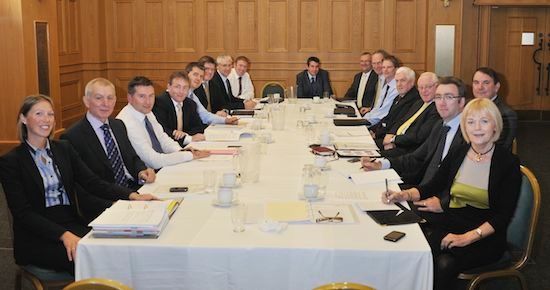
DARD DOE Meeting June 2011


NIGTA Appoints First Lady President.
The Northern Ireland Grain Trade Association has broken with tradition and elected a lady president at the Association’s recent annual general meeting.
Claudine Heron

Claudine Heron, who is a Senior Commodity Trader with W and R. Barnett Ltd qualified with a Masters in Engineering from Oxford in 1998 and as a graduate started her working career in the oil industry for Mobil and later BP, living in the London area.
After her marriage and a move to Nottingham in 2001 Claudine changed her career direction to work in the food industry as a Technical Brand Manager for Walkers Crisps, part of the Pepsico empire. There she managed the technical aspects of the Doritos and Sensations brands.
On her return to Northern Ireland she began working for W and R Barnett early in 2006 as a Commodity Trader and now, as a Senior Trader, has experience in managing a number of product books including soya.
Commenting on her role as President Claudine said that her priorities would include working with the farming and food organisations to ensure the future profitability of local food production, thus continuing to offer consumers the opportunity to purchase the very high standard of locally produced food.

She commented on the resilience of the agri food sector and the employment it has engendered and the potential for further growth, citing the leading employers in Northern Ireland who are all in the food industry.
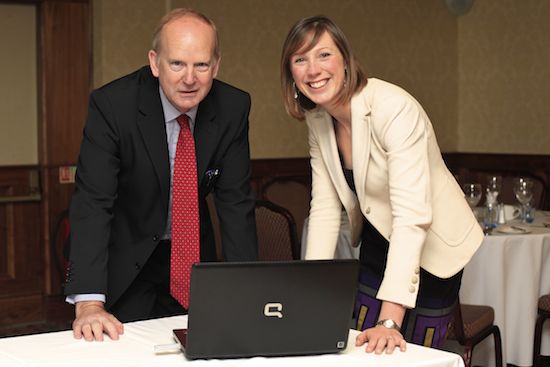
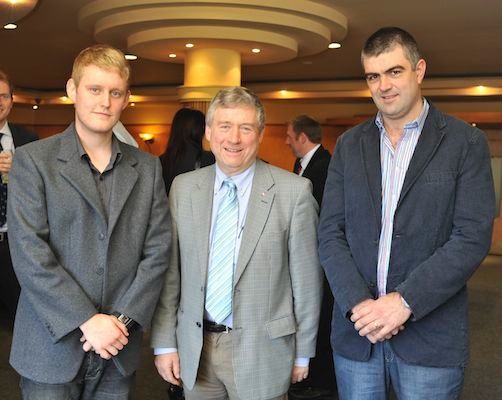
The new Northern Ireland Grain Trade Association President Claudine Heron pictured with Declan Billington, Immediate Past President; Stephen Burrell, Honorary Treasurer and David Malseed, Honorary Secretary.
Claudine is also keen to further progress the risk based sampling project which was introduced in the wake of the dioxin scare of 2008, and thus ensure that all risks that may affect the sector are catered for and that the industry can identify and prepare for emerging risks. She paid tribute to outgoing President, Declan Billington for the amount of time and effort he had devoted to this project during his year of office, in addition to all of the other NIGTA business and negotiations.
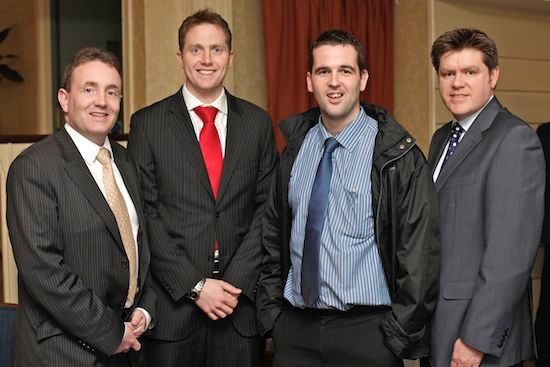
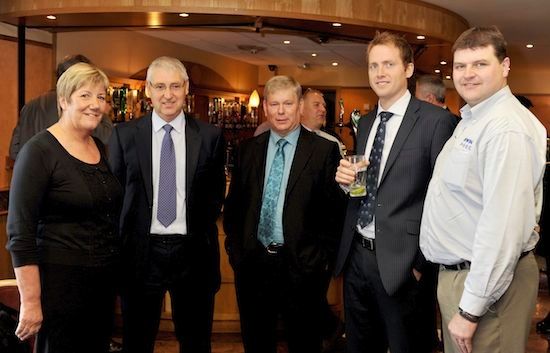
Claudine Heron the new NIGTA President chats to Alan Bristow, George McElnea and Peter Davidson at the Association's AGM in Holywood.
Regarding the membership of NIGTA she is keen to embrace all aspects of the feed industry and will be inviting those companies outside the Association to join and thus add to the negotiating power and quality standards of the Association.
Owen Brennan of Devenish Nutrition was elected Vice President , while David Malseed, United Molasses was re-elected Honorary Secretary and Stephen Burrell of United Feeds was re-elected Honorary Treasurer.
NIGTA AGM 2011






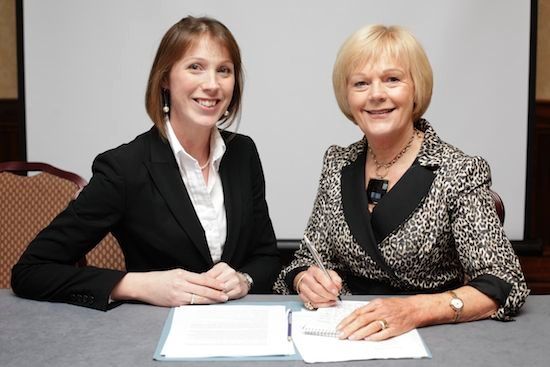






Agriculture Minister Michelle O'Neill has met with members of the north’s Grain Trade Association (NIGTA) led by their current President Claudine Herron.
NIGTA represents traders, manufacturers, processors, distributors, brokers and service providers who are involved in the north’s agricultural supply trade.
Speaking after the meeting, the Minister said: “NIGTA has a valuable contribution to make to the feed processing sector and as a result, to the wider agri-food industry. This has been a useful opportunity for me to discuss a range of issues and to listen to their views on the local animal feeds industry and wider agricultural sector.”
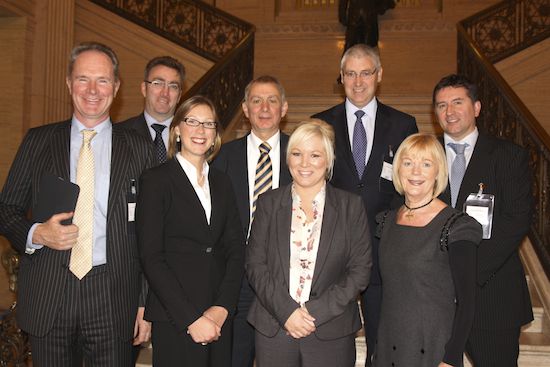
Agriculture Minister Michelle O'Neill with NIGTA Members.
NIGTA played a key role in developing the Industry Food Assurance Group report which proposed a ‘Fortress Ireland’ approach to minimise the risk of contaminated feed entering the feed/food chain on the island.
Minister O’Neill said: “I welcome NIGTA’s participation and support in the vision for ‘Fortress Ireland’ as an answer to supply chain security. I know there has been a strong partnership approach to this vision. I want to encourage businesses across the feed and food supply chains to fully engage in this initiative. This is essential to the production of safe food and the competiveness of our agri-food industry.”
The Minister also acknowledged the important and valuable contribution all the attendees are making to the agricultural industry.
Members of the Northern Ireland Grain Trade Association welcomed David Caffall, Chief Executive of Agricultural Industries Confederation (AIC) to their recent meeting and lunch.

AIC is NIGTA’s affiliated organisation in GB and assists with lobbying and technical advice, in addition to providing quality assurance schemes. In total the 260 members supply £7 billion of the £9 billion inputs to British agriculture.
Welcoming David Caffall to the meeting, Claudine Heron, NIGTA President said “ When you consider all aspects of the agri supply chain, it is far too many voices to provide a coherent lobbying and negotiating voice. In addition, individually none of us have the resources to supply the technical advice and provide the quality assurance schemes which are recognised throughout Europe. AIC provides these services and our role is to ensure that they take account of local circumstances. Through our networking within the industry we also provide lobbying information relevant to Northern Ireland which ensures that our viewpoint is included in AIC’s negotiations at Westminster and Brussels. These messages are further emphasised by our local lobbying.”
She added “ Many of the aspects we are negotiating at the moment are not confined to the feed trade but are matters which affect the farmer, out customer, and indeed the entire agri food chain. The agri food industry in Northern Ireland has demonstrated its success and growth in spite of the recession and its ability to contribute substantially to the economy. NIGTA wants to play its part in ensuring sustainability and continuity of that progress. We thank AIC for the support it gives to enable us to progress that aim “
AIC Meeting September 2011






Speech from President, Claudine Heron
New NIGTA President highlights crucial role for local agri food sectors

“The supermarkets are now the central link in the food retail chain. It is therefore incumbent on them to pay farmers realistic prices for their produce.” Claudine Heron, the new president of the NI Grain Trade Association (NIGTA) told representatives of the agri food industry attending the Association’s annual dinner.
Claudine Heron stressed the absolute necessity of retaining a sustainable farming sector in Northern Ireland.
She said “No longer are we viewed as an industry to be taken for granted. Instead in this period of economic uncertainty, we are seen as vital - the bread and butter of the economy in Northern Ireland. We haven’t, as the Agri-food Industry, enjoyed the highs during the boom years as some industries but generating in the region of 20,000 full-time jobs and a total of 92,000 agriculture dependent or associated jobs and £3.2bn of revenue for the province, we are now being recognised for our resilience.
“It is therefore incumbent on the supermarkets to pay farmers realistic prices for their produce. Numerous surveys have confirmed that local consumers want the continuing opportunity to select locally produced food. They will be prevented from doing this if retailers do not act to ensure the continuation of a viable farming industry here in Northern Ireland.”
Claudine highlighted the tremendous volatility on the world’s commodity markets at the present time. She went on to point out that the current economic climate is bringing additional challenges.
“Strong input costs such as fertiliser, fuel and electricity as well as fluctuating grain prices are putting our customers ‘the producer’ under extreme pressure as they struggle to achieve price increases,” she continued.
“The cautious approach taken by banks on credit and cash flow issues are part of the daily grind of business we are all dealing with against this backdrop of volatility. It is in our interest to ensure the end producer is profitable. We see it as our duty in NIGTA to support those in the dairy, beef , pig and poultry sectors, lobbying side by side with the Ulster Farmers Union, supporting their stance with the supermarkets to ensure the survival of our local producers, and our industry.
Claudine Heron is the Grain Trade’s first female President. She is also the youngest person to hold the position. An engineering graduate from Oxford, she firmly believes that the farming and food sectors can provide exciting career opportunities for large numbers of young people.

“The challenge of feeding the world’s growing population over the next four decades is one that will ensure the central importance of the various agri food sectors during the period ahead,” she told the guests attending NIGTA’s flagship event.
“And it is only the boundless ability, enthusiasm and energy of young people that will allow us meet our goal of feeding the world on a sustainable basis.”
The new Grain Trade President also highlighted the absolute importance for the feed industry on the island of Ireland to effectively bed down its new traceability and assurance priorities over the coming months.
“NIGTA’s significant involvement in the Northern Ireland Feed Assurance Group, led by Professor Patrick Wall has resulted in the recent release of a formal industry report,” she continued.
“Entitled ‘Assuring Food Safety in Northern Ireland’, the report details industry plans for reducing risks to the feed manufacturing, farming and processing sectors in Northern Ireland particular to the potential contamination of feed material inputs to these sectors.
“NIGTA has spent a year garnering support for our ‘Fortress Ireland’ vision as an answer to supply chain security following the 2008 Dioxin scare. In the coming months key stakeholders and representatives from different sectors of the grain trade, both north and south of the border, and in conjunction with our sister organisation IGFA, will work together to provide details of the practical execution of this vision, in partnership with Global Food Safety Expert Professor Chris Elliot and his team from Queen’s University.”
Claudine Heron concluded “Minimum standards of testing will be set and incorporated into a new risk based sampling assurance model. To close the gap to unscrupulous operators the food processors will in turn demand evidence of Feed and Food Assurance along the supply chain. This is something for us all to be proud of. With the guidance of Professor Patrick Wall and Professor Chris Elliott we as an industry have taken a proactive approach to address a potentially fatal issue.”
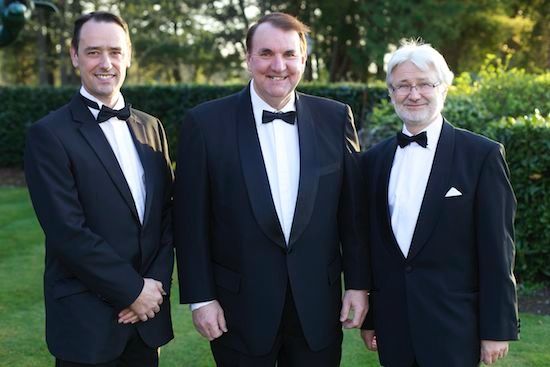
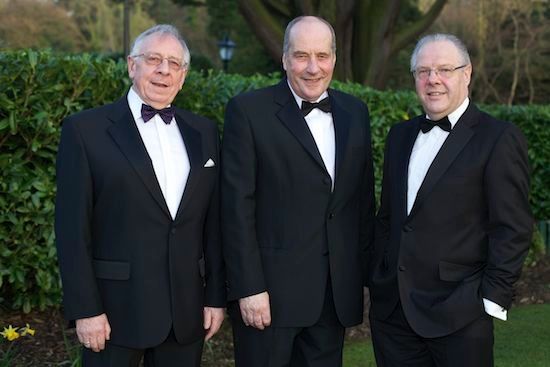
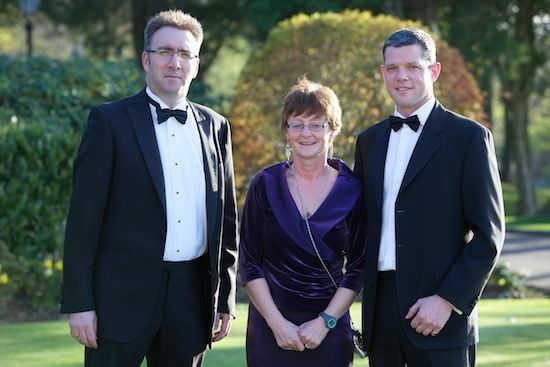
NIGTA Annual Dinner 2011























Whilst price volatility has continued on the world markets in recent weeks, farmers here have been protected to a degree, by Northern Ireland compounders acting as a buffer. The forward buying patterns of the NI Grain Trade Association members have meant that they have had feed stocks in hand and have literally been trading below full market prices for the last ten to twelve months. Furthermore a time lag in price increases over the winter period has helped avoid some of the more extreme price spikes.
But as winter contracts are unwound it is inevitable that farmers are going to experience an increase in their feed bill. Feed compounders will now be operating at the full market price to replace stocks and this will make summer rations more expensive than current levels. Recent events such as the political unrest in Libya and the catastrophic earthquake in Japan have caused commodity prices to swing dramatically within a single day, and prices remain at the high end of historic levels
After a period of weaker sentiment, Thursday saw world corn and bean markets trading sharply higher due to tight stock estimates from the US Department of Agriculture. Speculators have driven some of the volatility as they move money in and out of commodities in an attempt to hedge price inflation. The underlying fundamental demand has kept prices supported with concerns around supply, obviously security of food supply concerns all governments against a background of world population growth but it was of specific concern this year due to the drought in Russia and floods in Australia.
Currently the market is looking for confirmation of large world crops before any possibility of easing prices. This will also mean a very reactive market to any weather scares as the growing season progresses towards harvest. Continued demand from developing countries such as China is supportive at a time of tight supply and will only serve to exacerbate market nervousness, driving prices higher.
The Northern Ireland Agri-Food Supply chain is not immune from world raw material market price rises. Being a global event, the impact will be felt equally by farmers around the world, whom all need to achieve cost recovery. As importers and feed compounders the NI Grain Trade Association members are the first to see the impact of higher prices - with compound price rises unable to keep pace with the world markets, there are tough times ahead for farmers facing the reality of summer contracts.
Retailers will face the same demand from all their suppliers, local or international, to address rising input costs. It is only a question of how long they can resist the call and what damage is done to the local industry as a consequence. Farm gate prices need to reflect these increased production costs and the retail sector must be supportive by ensuring that sufficient returns are passed back down the supply chain or they are in danger of severely damaging the long-term viability of the Northern Irish food supply chain. Indeed, our government must recognise that in times of austerity, national governments will hoard, rather than export food into the world market. Where will the supermarkets turn to then, when the local supply base has been too crippled to step into the breach?
- You are here:
-
Home

- NEWS-UPDATE