The EU Office in Belfast is the eyes and ears of the Commission in Northern Ireland and is constantly alert to what the EU can offer here whether that is economically, politically or socially - but Northern Ireland must make its views known and negotiate through London, according to Colette Fitzgerald Head of the EU office in Belfast.
Speaking at a NI Grain Trade Association lunch, Colette referred to May 2007 and the signing of the Good Friday agreement when £2 billion European Peace Money was awarded to develop the economy in Northern Ireland and grow the private sector.
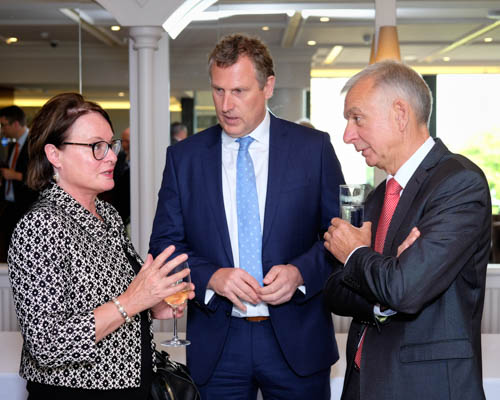
For the past seven years the EU office has been helping Northern Ireland to access the Horizon 20/20 fund of 80 billion euro. Northern Ireland has been awarded £175 million from this fund and Colette is very keen to increase Northern Ireland's engagement.
As head of the EU’s Belfast office Colette stressed that all of the Northern Ireland issues are reported back to Brussels on a daily basis and are considered along with those from all of the other member states. However NI is not a member state so has no direct voice – it must communicate with the EU through the UK's negotiating structure. For this reason NI must get its message across in London and hope to achieve a favourable outcome for Northern Ireland in the negotiated settlement.
Colette went on to point out that the EU negotiators understand Northern Ireland through involvement in the peace program and will be keen to see a solution which works for the whole of Ireland. While there is a two year window for Brexit negotiations each country will have to approve the deal between the EU27 and the UK and finally the EU parliament has to approve the deal.
It will be a lengthy process and it must be remembered Brexit is not as big an issue for the rest of the EU as it is for Britain - their attention is focused on the EU budget for 2020 which costs each country 0.9% of its GDP.
She finished by pointing out that the scale of what needs to be negotiated is mind boggling – everyone is in uncharted waters and the impact on Northern Ireland will depend very much on our ability to influence opinion in London.
NIGTA June Meeting 2017


The Northern Ireland Grain Trade Association is pleased to announce the election of Dr. Keith Agnew, Chief Executive of United Feeds Ltd, as its President for 2017.
Keith's main area of interest has been nutrition and management of the dairy cow and he has held a number of nutritional and advisory posts within the industry. He was appointed Chief Executive of United Feeds in September 2013 and is a member of the advisory board for the Canadian company, Fermentrics. He is also current President of the Northern Ireland Institute of Agricultural Science.

During his year as NIGTA President he hopes to assist in further development of training modules for feed advisers, trade awareness courses for new entrants to the industry, and support Food Fortress, the world leading quality control system for the feed trade. Keith is also taking a keen interest and involvement in Brexit negotiations and sits on DAERA's Brexit Consultative Committee.Partnerships and negotiations with other trade associations will also be a priority in order to support the local agrifood industry.
After graduating from Queen’s University, Belfast in 1989, Keith spent three years at the Agricultural Research Institute of Northern Ireland (now AFBI) studying for a PhD in dairy cow nutrition. After this, Keith joined DARD (now DAERA) as a lecturer at Greenmount College (CAFRE) before entering the animal feed industry in 1995. In 2002 he took up a Business Development role with United Feeds.
United Feeds is part of the Dale Farm Group, which is the largest milk processor in Northern Ireland. Within his roles, Keith has been responsible for the commercial team as well as product development, R&D programmes and on farm support. During his career, Keith has presented papers at numerous international conferences and meetings in Europe, Canada and the USA.
Outside of work he is involved with the Replay Theatre Company, which produces work for young people from babies to 19 years old, particularly those with Multiple Learning Difficulties, He is also a keen Ulster Rugby supporter.t babies to the oldest teenagers, for children and young people with Profoun
“Agribusiness and Farming organisations must join forces with the Food Industry to speak with one voice as the Brexit negotiations get under way” according to David Caffall, the chief executive of the Agricultural Industries Confederation (AIC).

Speaking at a meeting of the Northern Ireland Grain Trade Association in Belfast Mr Caffall said “Unless the whole industry works together we won’t even feature in the planning process. While agri-food is big business in Northern Ireland – it represents a very small part of the overall UK economy and is in danger of being overlooked in favour of other, more powerful sectors”.
AIC have been active in bringing together an alliance of all the trades which supply goods and services to farmers and hope to coalesce with other like-minded bodies to create a single powerful voice which can have influence – not just at the DEFRA table but with David Davis, Liam Fox and even the Chancellor. “Given the global nature of our supply chains it is vital that we fight hard to ensure that trade flows are not disrupted in the deals which are done around the Brexit table”.
Since its inception AIC has always been focussed on Brussels based regulation and this remains a priority while the UK continues in membership of the EU. This is still vitally important work and AIC staff will continue to lobby on all relevant legislation being developed. “We must also look forward however and despite limited information from Government we have been busy identifying the priorities in terms of legislation which needs to be implemented from day one when the “Great Repeal Bill” is activated. This is doubling the workload and will put us under considerable pressure in the months ahead but it is essential that our staff and members are available to the relevant government departments given the vast expertise we can bring to bear on the issues of trade and regulation” said Mr Caffall.
NIGTA December Meeting 2016


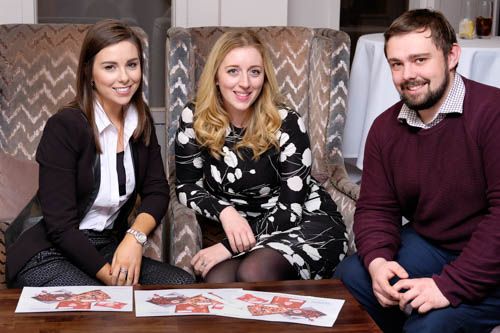

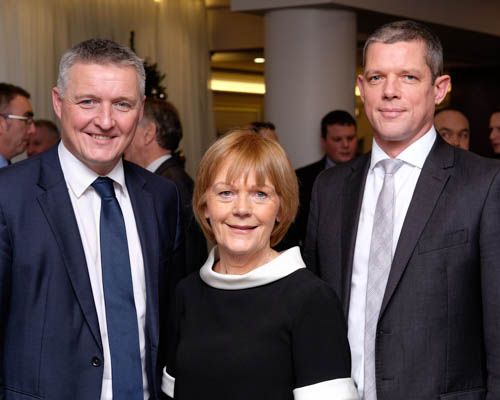





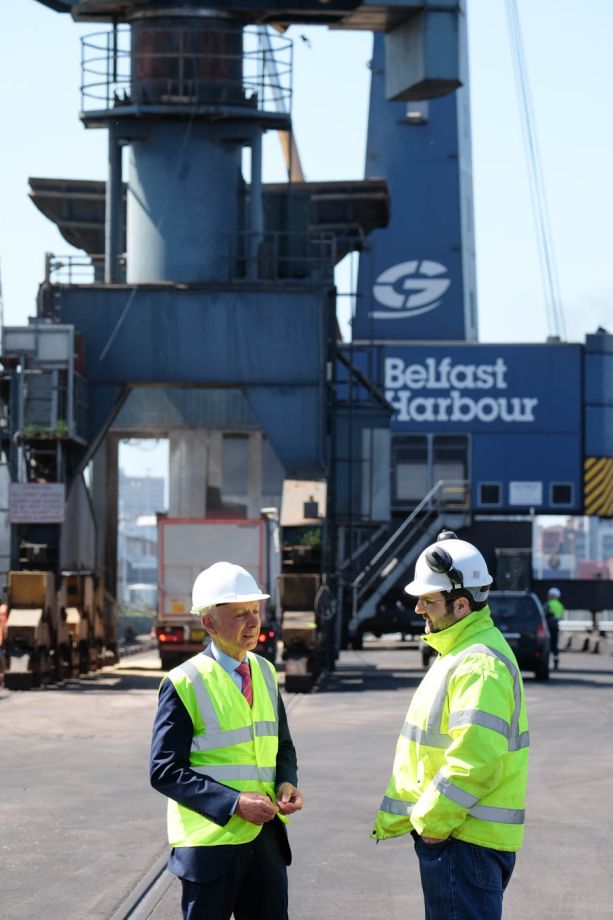
A Trade Awareness course, designed particularly for new entrants to the animal feed trade and organised by the NI Grain Trade Association outlined the different elements of the animal feed supply chain from Global sourcing of raw materials to feed manufacture and distribution.

The program was centred on the Belfast Harbour area where Joe O’ Neil, commercial manager of the Belfast Harbour outlined the vital role of imports with over two million tonnes of feed materials landed at the port every year.
This was followed by a tour of the harbour stores and a visit to the MV Bao Lucky – a massive ocean going vessel just arrived with her cargo of soya products from South America.
The manufacture of compound feeds came under the spotlight with a feed mill tour and presentations on quality assurance schemes including the world leading Food Fortress program developed in partnership with the Institute of Global Food Security at Queens University.
The importance of Research and development was discussed, highlighting the significant investments which had been made to improve feed efficiency and reduce costs of production.
The program concluded with a presentation detailing the role of the trade in reducing the environmental impact of intensive farming through management of greenhouse gas emissions and in reducing the levels of phosphate in our waterways.
NIGTA Trade Awareness Course June 2016




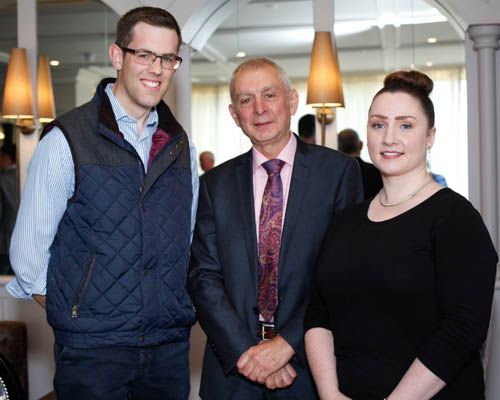
Keith Agnew, President, Northern Ireland Grain Trade Association recently presented a cheque to Sandra Spence, Marie Curie, his chosen charity.
The sum of £6235 was raised at the recent NIGTA Annual Dinner in the Culloden.

Wesley Aston, Chief Executive , UFU was the speaker at the quarterly lunch of the NI Grain Trade Association He pointed out that the UFU had taken on two new members of staff in order to focus in Brexit.

He outlined the expected political process around Brexit and the need for NI’s voice to be heard clearly during the negotiations.
He also detailed the key issues which had to be addressed on trade, the NI/RoI border, direct support, labour and regulation and gave an update on the UFU’s intended action plan to progress these issues, particularly around direct support with a view to reaching a single, common position locally with the wider agri-food industry and environmental organisations.
“Cautious optimism” was how Dr Mike Johnston, NI Director, Dairy UK described the outlook for the dairy industry when he spoke at the NI Grain Trade Association lunch last week. He pointed out that market returns were increasing and he expected this to be reflected in producer prices in the fourth quarter of 2016 as the effects of product forward sold by dairy companies work out of the system.

Mike referred to some of the reasons for market improvement, including an easing of milk production globally, with reductions in EU, GB, NI and New Zealand.
Culling of dairy cows has been a factor in these reductions with cull cows up 3% for July in Northern Ireland; France up 10% and Netherlands 15%.
While all of this sounds promising, Mike sounded a note of caution and reminded his audience that there are 260,000 tonnes of milk powder in EU Intervention and July stocks of butter in the USA were the highest in 100 years. He emphasised that it is difficult to predict the future based on previous experience of dairy volatility cycles since this is the first recovery from a trough the industry has experienced without quotas.
Referring to the possible impact of Brexit on the NI dairy industry, Mike said that although there are more questions than answers at present, the industry’s stance is “business as usual”. However, in terms of servicing the needs of customers in home and export markets the focus continues to be to be on quality and safety: “grass will continue to grow, and cows will continue to produce milk, and we will continue to ensure that our customers have a supply of high quality dairy products from NI”.
Mike concluded by describing the steps being considered by an industry group representing the complete supply chain, to minimise the uncertainty that comes with volatility in the industry. He added “ All businesses within the dairy supply chain need to minimise uncertainty and risk in their decision making. The group has been considering all possibilities, such as partnerships within a more joined up supply chain. We are also looking at systems used in other countries to assist the industry during periods of extreme volatility.”
NIGTA September Meeting 2016




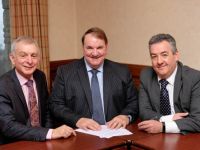
David O'Connor, President of the NI Grain Trade Association was delighted to hand over a cheque for £4541.00 to Rural Support, his chosen charity for 2016.

Speaking at the cheque presentation, David said that the mentoring and support requested by rural dwellers had increased immensely in the past year or so, due to the downturn in farm incomes, yet Rural Support, with their small team, had coped admirably with the extra work. David went on to stress that Rural Support is helping everyone in rural areas and is dealing with a wide range of requests including finance, relationships, forward planning etc.

He added “The range of mentoring and support has made such a difference to many rural dwellers and farming families, and yet it is being achieved with a very small team of people. They are deserving of our support and we wish them well for the future.”
David added that he would also like to thank NIGTA members and their guests for their generosity at the annual dinner.

- You are here:
-
Home

- NEWS-UPDATE